


Traditional retail largely depended on customers visiting a physical store to discover and purchase products. Today, digital commerce has changed that journey.
Customers can discover products online, purchase through an ecommerce website or mobile app, place an order by phone, buy through marketplaces, or visit a physical store. For modern retailers, the challenge is no longer simply having multiple sales channels - the real challenge is making all those channels work together as one unified retail operation. This is where omnichannel retail becomes essential.
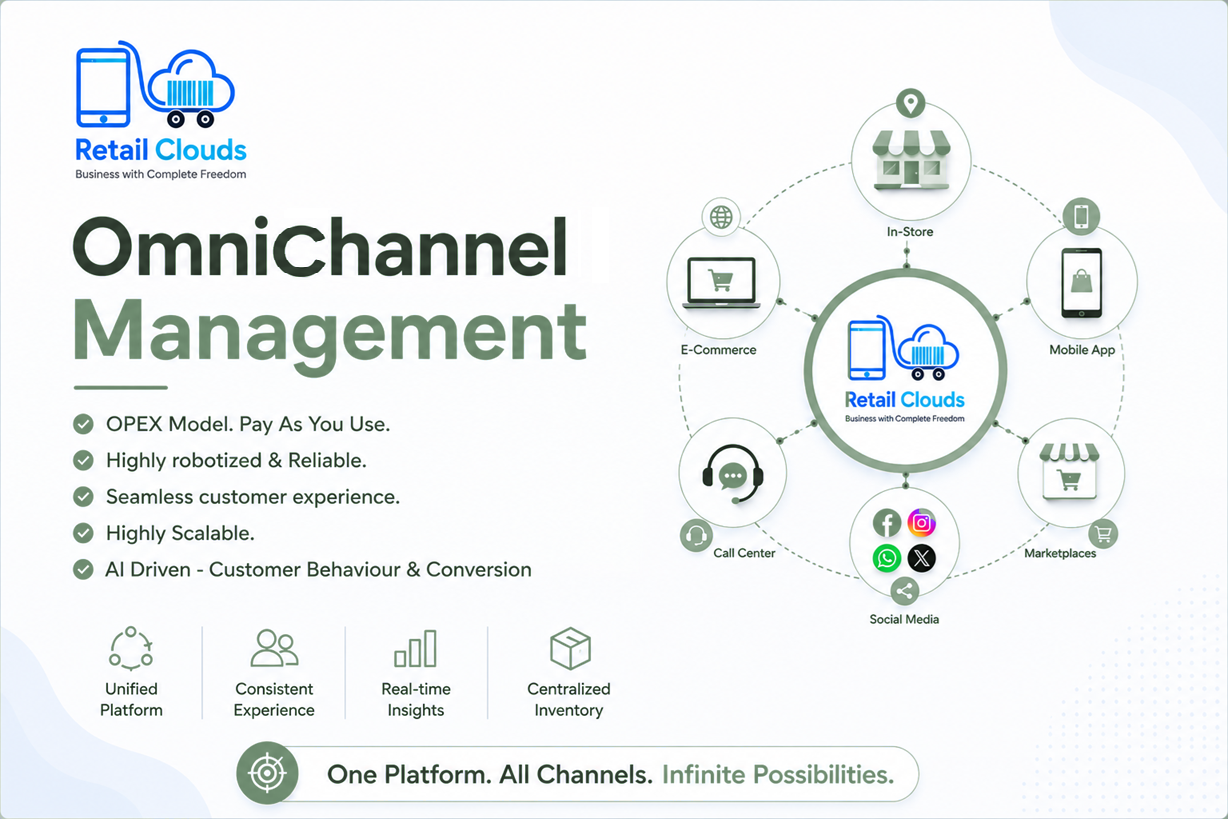
With the digital revolution, retail businesses now have multiple sales channels to fulfil. POS (Point of Sale), eCommerce site, mobile app, telephonic orders, and multiple marketplaces are the common sales channels for modern retail businesses. In other words, retail businesses must have omnichannel capabilities. The next immediate question is: what is the IT infrastructure requirement, and how do you meet omnichannel requirements?
Omnichannel retail is an approach where all customer-facing sales and service channels are connected through a unified retail ecosystem. Instead of operating stores, ecommerce, mobile apps, marketplaces and other channels independently, an omnichannel platform enables them to share relevant data, inventory, orders, promotions and customer information.
What Does an Omnichannel Retail Platform Need?
- Warehouse Management (WMS) & Supply Chain
- Outlet Management & POS
- eCommerce Site
- Customer Mobile Apps (Android & iOS)
- Marketplace Integration (Amazon, Flipkart, Myntra, and so on)
- Telephonic Orders
- Field Sales Person App
- Order Management
- Door Delivery, Payments & Logistics Partner Integration
Many traditional ERP implementations were designed primarily around back-office processes and may require additional commerce, marketplace, order-management and integration layers to support a complete omnichannel experience. As a result, retailers may end up managing multiple applications and integrations - increasing implementation complexity, cost and maintenance requirements. The solution is a cloud-based omnichannel retail platform that supports every sales channel and beyond.
How Can Retailers Build an Omnichannel Ecosystem?
A cloud-based omnichannel retail software can simplify this architecture by bringing multiple retail operations and customer channels together within a unified platform.
TechnoLabs developed Retail Clouds as a unified omnichannel retail platform designed to connect retail stores, POS, ecommerce, mobile applications, marketplaces, order management, inventory and fulfilment.With deep roots in research and development, Retail Clouds offers a few niche features like geo-fencing, order routing using GPS coordinates, access to real-time inventory, and more.
Whichever platform you evaluate, these are the capabilities worth checking for: full channel coverage, real-time inventory across locations, unified customer data, and a pricing model that doesn't require large upfront investment. Here's how Retail Clouds specifically addresses each of them:
Why Retailers Choose Retail Clouds ?
- No CAPEX. Pay as you use.
- Seamless customer experience across all channels.
- One-point MDM (Master Data Management) for all channels.
- eCommerce site can be made ready in a matter of hours.
- White-labelled customer app.
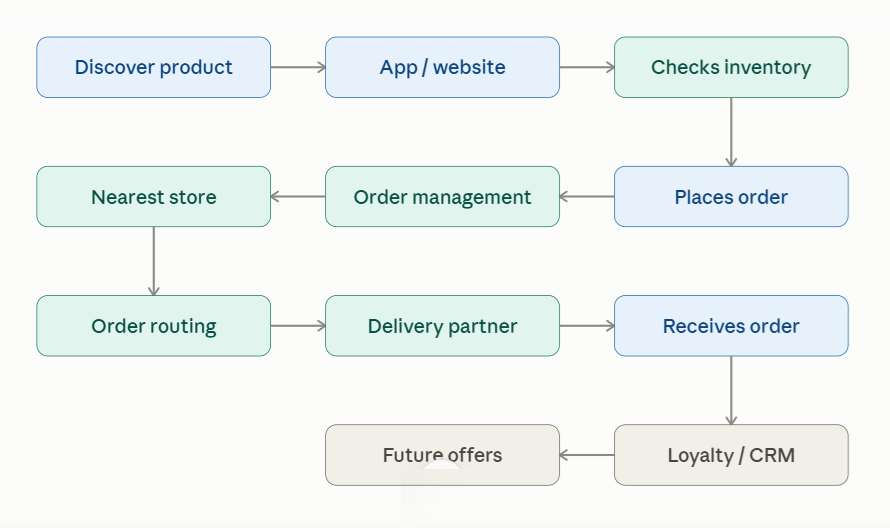
- Picks real-time stock from the nearest store or warehouse and shows it online.
- Routes orders to the nearest fulfilment centre by calculating Google distance.
- Promotions are seamless across all channels.
- Customer loyalty is seamless as well.
- AI-based customer behaviour analysis available for better conversion, both at storefront and online, as a niche service.
The same can be experienced by calling for a live demo.
See Retail Clouds in action
Get a live walkthrough of how Retail Clouds connects your online, mobile and in-store sales channels through one omnichannel retail platform.
Request a Live DemoFrequently Asked Questions
| Multichannel | Omnichannel | |
|---|---|---|
| Channels | Multiple, independent | Multiple, connected |
| Inventory | Siloed per channel | Unified, real-time |
| Customer data | Fragmented | Single customer view |
| Experience | Disjointed | Seamless across channels |
Final Thoughts
Omnichannel retail is no longer simply about selling through multiple channels. It is about creating one connected retail ecosystem where stores, ecommerce, mobile, marketplaces, inventory, orders, fulfilment and customer engagement work together.
For retailers, the goal is simple: give customers the freedom to shop wherever they want while giving the business a unified view of products, inventory, orders and customers.
A cloud-based omnichannel platform such as Retail Clouds can help retailers build this connected ecosystem without having to manage a collection of disconnected systems.