


Choosing retail software is rarely as simple as comparing feature lists. Two platforms can look nearly identical on a sales deck and still perform very differently once they are running a live store, a warehouse, and an online storefront at the same time. That is where benchmarking comes in.
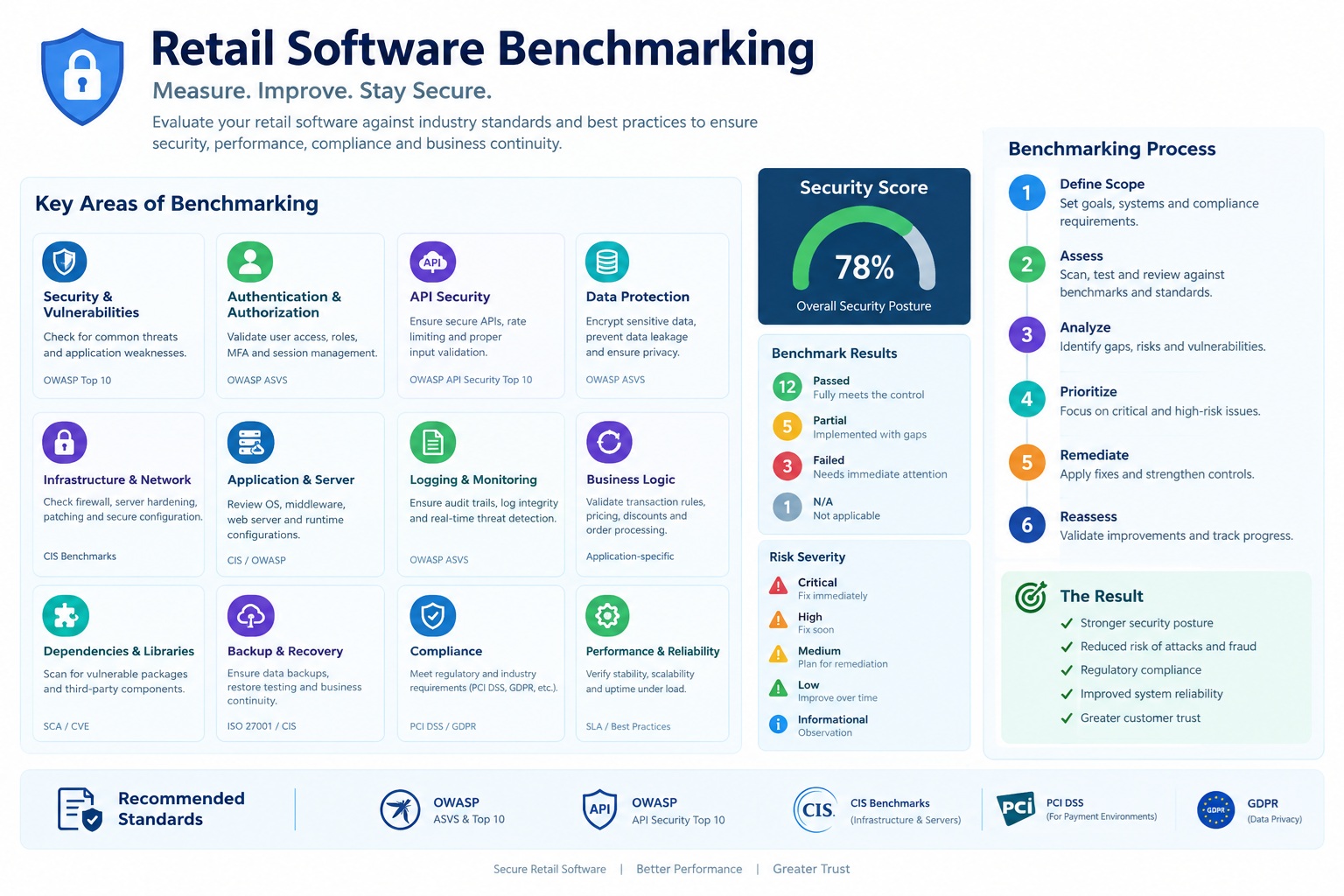
Retail businesses need a structured set of benchmarking parameters to compare vendors objectively and make the right software decision. Rather than treating every requirement as equally important, it helps to group them into three categories: Functional Benchmarking, Performance Benchmarking, and Security Benchmarking. Together, these three pillars give a complete picture of whether a platform can actually run your business - not just demo well.
Functional Benchmarking
Does the software cover the day-to-day operational needs of your retail format - from procurement to POS to delivery?
Performance Benchmarking
Does it stay fast, available, and scalable under real transaction volume, across every module?
Security Benchmarking
Is customer, payment, and business data protected to the standard your industry and regulators expect?
1. Functional Benchmarking
Functional benchmarking determines whether the software meets the basic operational requirements of running a retail business. The right mix of capabilities varies by format - supermarkets, fashion and lifestyle, food and beverage, pharma, wellness, white goods, and perishables such as meat and vegetables all carry their own specific requirements - but nine functional areas show up again and again as non-negotiable:
- Demand Forecast and Procurement
- Warehouse Management
- POS & Outlet Management
- eCommerce Site
- Customer App
- Door Delivery & Logistics Integration
- Campaign Management & Promotions
- Reports & Analytics
- Audit
Here is what to look for in each area.
1.1 Demand Forecast & Procurement
Several demand-forecasting methods exist today, ranging from classical statistical models to AI-driven approaches. Whichever method a vendor uses, the output must satisfy your actual inventory requirements - forecasting for its own sake is not useful if it does not translate into better stock decisions.
1.2 Warehouse Management
At minimum, retail software should support:
- Warehouses and distribution centers
- Goods receipts and invoicing
- Labelling and batch management
- Storage management
- Item-level tracking for white goods
- Pick lists and order fulfillment
- Ageing and FIFO (first-in, first-out) handling
1.3 POS & Outlet Management
The system must be able to manage every operation at the outlet level, including:
- Stock management
- Batch operations and ageing
- B2C and B2B billing, both online and offline
- Order fulfillment
- Manual and automatic discounts
- Customer loyalty support
- Full participation in an omnichannel experience
- Taxation rules specific to the relevant country and state
- Both FOFO (franchise-owned, franchise-operated) and COCO (company-owned, company-operated) outlet models
- Store-level reporting
1.4 eCommerce
Online is no longer optional for retail brands - beyond incremental sales, a strong online presence builds brand value in its own right. A capable eCommerce site should offer:
- A choice of user experience for customers
- Fully responsive design
- Support for all common payment options
- Real-time inventory visibility from the nearest fulfillment center
- Full integration with the omnichannel platform
- Customer feedback and ratings
- Customer order management
1.5 Mobile App
Retailers need both Android and iOS apps, built to the same standard:
- Customized user experience
- Support for all payment options
- Full participation in the omnichannel platform
- Real-time inventory access from the nearest fulfillment center
- Customer feedback and ratings
- Customer order management
1.6 Door Delivery & Logistics Integration
Once you operate multiple sales channels, door-delivery capability becomes essential:
- Support for Android devices used by delivery staff
- Support for payments collected at the customer’s door
- Integration with logistics partners for delivery execution
- Live monitoring and control of deliveries via GPS tracking
- Vehicle and route management, for retailers running their own delivery fleet
1.7 Campaign Management & Promotions
The platform should have built-in capability to launch campaigns alongside promotions and discounts:
- System-suggested customer segments and promotions
- Support for email, SMS, WhatsApp, and other social channels
- The ability to track how effective each campaign actually is
1.8 Reports & Analytics
Whatever retail software you choose, it needs strong reporting and analytics. Check specifically for:
- Sales reports
- Stock reports
- Order management reports
- Campaign management reports
- Financial reports, where the vendor also offers financial management
- Outlet and cashier performance reports
1.9 Audit
Finally, the integrity of the software itself is non-negotiable. At minimum, it should provide:
- A timestamped record of every new transaction and update
- A clear log of which user and role performed each transaction
- Protection against permanent deletion of records - records should be marked as deleted, never erased outright
2. Performance Benchmarking
Performance benchmarking applies across every module, including eCommerce, and covers how the system behaves under real-world load rather than in a controlled demo. The parameters below are the ones worth holding every vendor to:
- Native apps are essential for POS and outlet management - not web wrappers.
- Downtime must be zero wherever the system faces the customer directly.
- Scalability should be built on distributed cloud computing, which keeps both cost and downtime down as demand grows.
- Response time for transactional operations should stay under two seconds, except where a third-party integration is involved.
- Real-time integration should be the norm across the board; batch uploading should be avoided wherever possible.
- Ease of use matters as much as raw capability - the interface should be intuitive and offer contextual help.
- Replication to a failover backup server must happen in real time.
- Backup and recovery should include both regular full backups and incremental backups.
Why it matters: functional richness means little if the system buckles at peak hours. Performance benchmarking is how you catch that before go-live, not after.
3. Security Benchmarking
Every native and web application in the stack - POS, eCommerce, mobile, and back office alike - should be held to the same security bar:
- All retail applications in use should be VAPT (Vulnerability Assessment and Penetration Testing) certified.
- All traffic should be encrypted, using SSL or, preferably, TLS.
- All retail applications should enforce session timeouts, ideally configurable dynamically.
- User access should be controlled through individual user IDs and passwords.
- Two-factor authentication should be implemented wherever possible.
- Device-level access control is a strong plus - unactivated devices should have no access at all.
- Every API should enforce token-based access control.
- A strong firewall should sit at the cloud server level.
- Failed login attempts should be detected, with accounts locked out accordingly.
- There should be no direct access to the application server - a reverse proxy should sit in front of it.
Security is not a checkbox exercise completed once at contract signing. It is a standing requirement that should be re-verified as your retail software evolves and scales.
Bringing It Together
No single feature makes retail software the right choice. What matters is whether a platform can meet the operational depth your retail format demands (Functional Benchmarking), hold up under real transaction load without friction (Performance Benchmarking), and protect your business and customer data to a defensible standard (Security Benchmarking).
Used together, these three categories turn a vendor comparison from a subjective, feature-list exercise into a structured, defensible decision - one that stands up not just at go-live, but years into the relationship.