


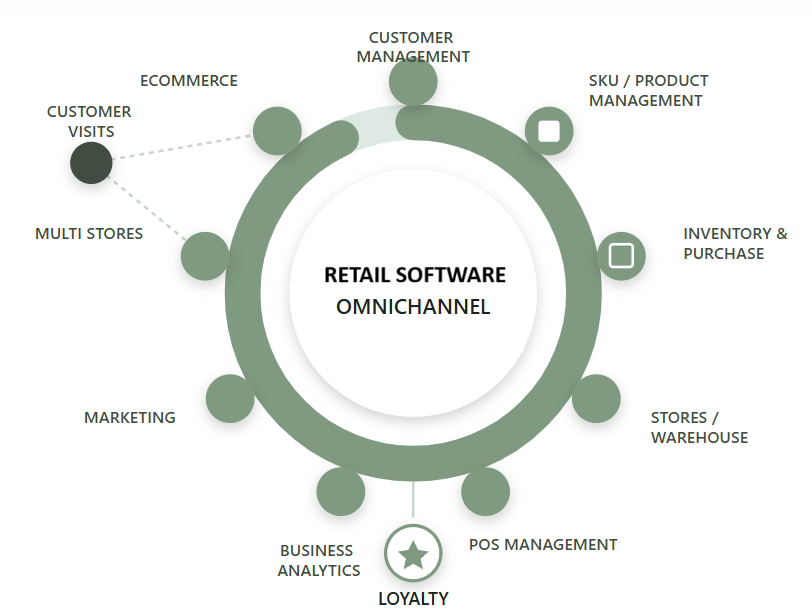
Ask ten people what "retail software" means and you'll likely get ten different answers - a POS system, an inventory tool, an online store. In reality, none of these on their own is enough. Modern retail runs on something broader.
What Constitutes Retail Software?
Modern retail software needs to bring together every functional module required to run both the physical store and the online business, under one roof. That means a single platform capable of managing warehouses, distribution centers, and outlets, while also powering the eCommerce site and the customer-facing mobile app.
Crucially, all of this should work seamlessly within one platform - not as a patchwork of separate systems stitched together from different vendors. Software that achieves this is what we call Omnichannel Retail Software: a single system where every channel, from the store counter to the checkout screen on a customer's phone, draws on the same data and works to the same rules.
Beyond the Core: Where Retail Software Is Headed
Beyond these core modules, retail platforms increasingly branch into more specialized territory. Customer loyalty programs, queue-busting tools, and self-checkout systems are becoming common additions rather than nice-to-haves.
Looking further ahead, artificial intelligence is starting to reshape what retail software can do - from AI-driven demand forecasting, to AI-powered analysis of customer behavior, to early experiments in AI-driven virtual shopping experiences.
The takeaway: retail software is no longer a single tool solving a single problem. It is the connective layer that lets stores, warehouses, apps, and websites operate as one business rather than several disconnected ones.